Mathematical operations and equation solving with reconfigurable metadevices
Reading the Miller and direct complex matrix architectures for reconfigurable equation solving.

English translation of the author’s Chinese Zhihu article, preserving its original date and viewpoints. Figures retain the original labels; click a figure to enlarge it.
This paper, published in LSA by Nader Engheta’s group at UPenn, examines at the architectural level how metadevices can be used to solve matrix formulations of integral and differential equations. It focuses on the Miller architecture, which requires singular value decomposition, and a more intuitive direct complex matrix (DCM) architecture introduced here, which requires no prior mathematical decomposition.
Most MZI-based systems use one of the following network designs: (a) Reck, a pioneering design in optics and quantum applications; (b) Miller, with self-configuration capabilities; and (c) Clements, with balanced path lengths. All three require a prior mathematical decomposition of the main operator.
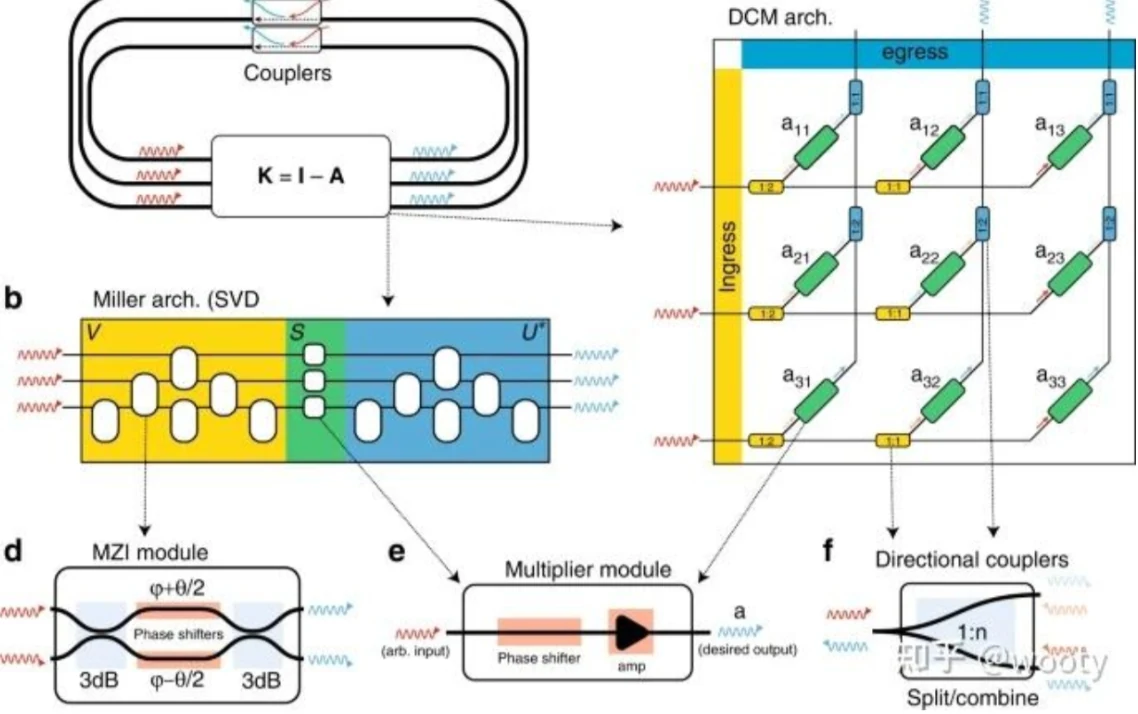
Solving mathematical equations—or equivalently computing the inverse of matrix A—requires implementing an operator, K = I − A, within a looped system. Two reconfigurable architectures are considered here.
b. The Miller architecture consists of three stages corresponding to the three matrices in a singular value decomposition. Stages V and U can be implemented as cascades of Mach–Zehnder interferometers (MZI, d). Stage S can instead use MZIs or multiplier modules (e), in which an input signal is modified by phase shifters and amplification or attenuation units.
c. The proposed DCM architecture offers a more direct, intuitive implementation of the same operator. The input stage comprises directional couplers (f) with fixed splitting ratios. Each output drives a dedicated multiplier (e), which is assigned the required matrix value—shown here for a 3 × 3 matrix. Finally, a set of directional couplers (f) recombines the signals at the output. An MZI module can be reconfigured as two 3 dB couplers and two multipliers, making the multiplier module a principal building block of both architectures.
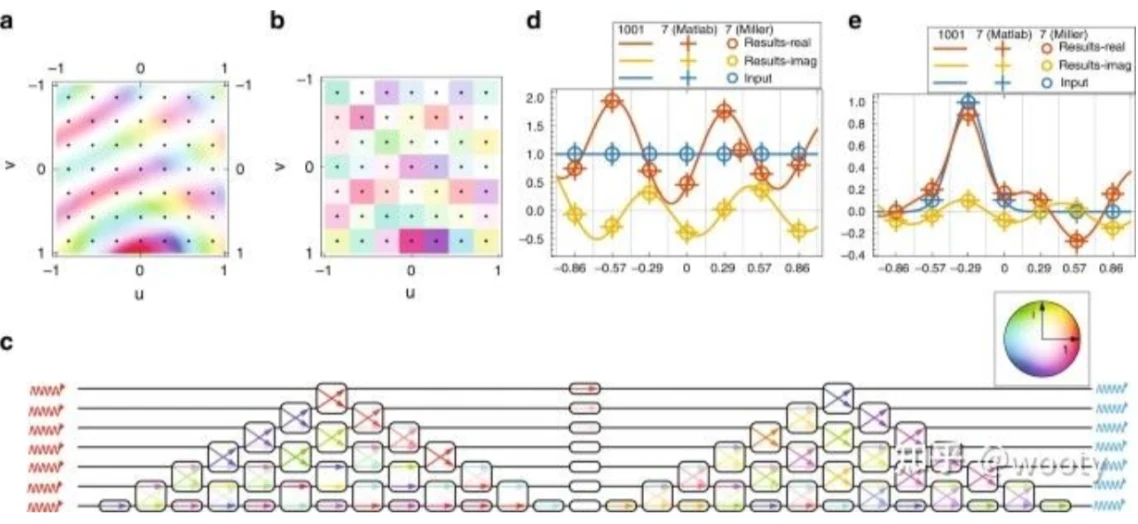
The Engheta group’s paper has a clear narrative and is worth reading closely! Today’s note is rough; I will revise it another day.
Reference
Tzarouchis, D. C., Mencagli, M. J., Edwards, B. et al. Mathematical operations and equation solving with reconfigurable metadevices. Light: Science & Applications 11, 263 (2022).