Integrated photonic neuromorphic computing: opportunities and challenges
Notes on 3D integration, coherent and incoherent architectures, and photonic spiking neural networks.

English translation of the author’s Chinese Zhihu article, preserving its original date and viewpoints. Figures retain the original labels; click a figure to enlarge it. A short passage at the beginning is obscured in the source screenshot and has not been guessed or reconstructed.
In a review published in Nature Reviews Electrical Engineering, a team at Oxford discusses integrated synaptic…
A passage here is hidden by Zhihu’s floating toolbar in the supplied screenshot. It has not been reconstructed.
…(2) coherent electro-optical processors and (3) all-optical neural networks, including photonic spiking neural networks (SNNs).
The first particularly interesting idea is the move of integrated photonics toward 3D. Free-space optical systems offer great flexibility and spatial degrees of freedom, while integrated optical systems offer miniaturization and a wider range of potential applications. One exciting prospect is to combine conventional active free-space components—such as vertical-cavity surface-emitting laser arrays, spatial light modulators, volume storage, and diffractive elements—with integrated circuits.
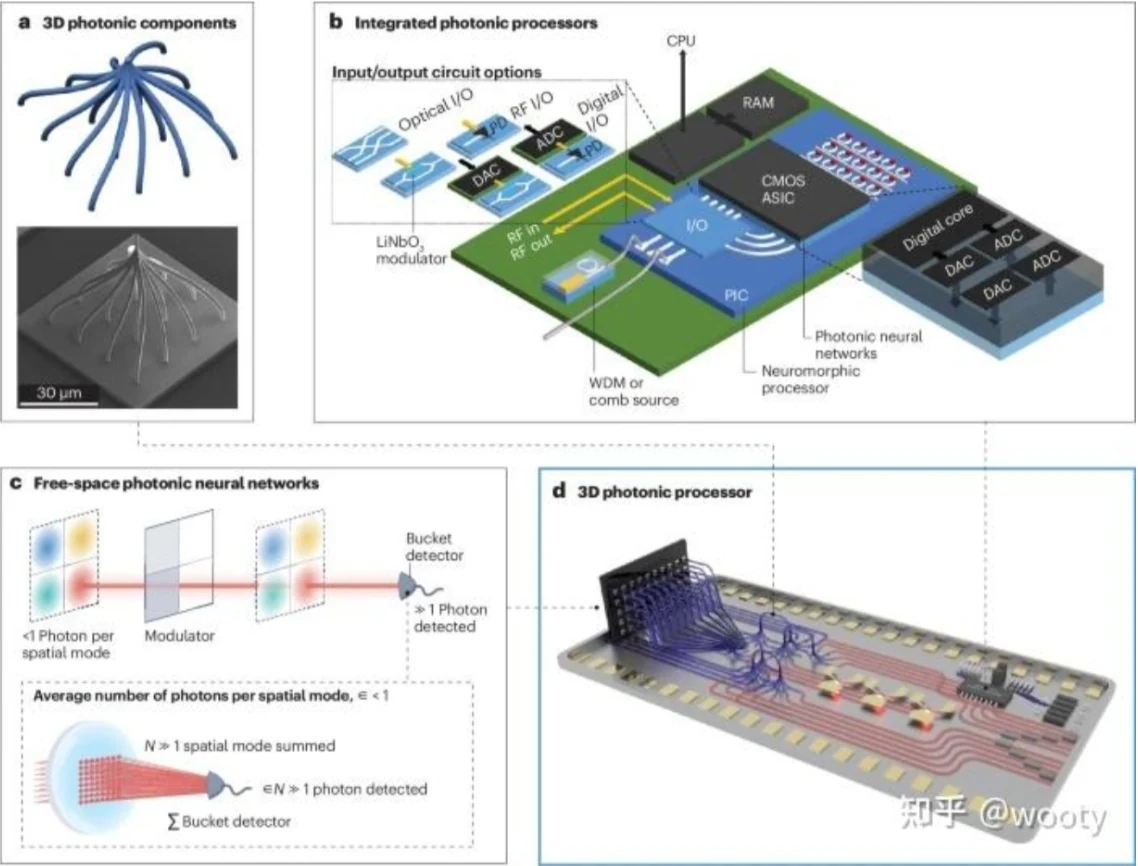
The second point concerns coherent approaches being suitable for cascading and incoherent approaches for parallelism in neuromorphic computing. In the former, summation is performed in the electronic domain; in the latter, optical signals are added directly through interference in the optical domain. Information is converted into an electrical signal by a photodetector only after optical multiply–accumulate operations. Coherent approaches also retain optical information—amplitude, phase, and mode—after each addition. Together with the requirement for a single light source, this gives coherent optical accelerators a clear advantage in cascading. By contrast, incoherent approaches can straightforwardly operate in parallel on input vectors sharing the same weight matrix, separated in wavelength by multiplexing. This is cumbersome for coherent approaches because it is difficult to control optical phase accurately across different wavelengths simultaneously.
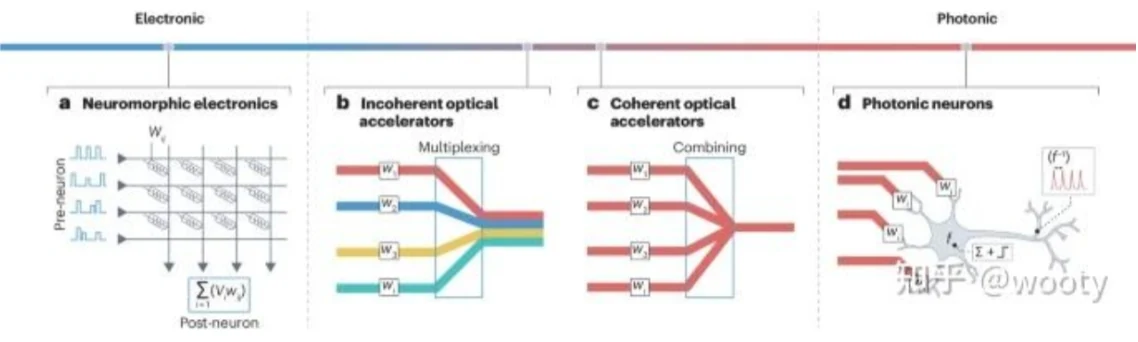
The third point concerns the energy efficiency and nonlinearity of spiking neural networks. Spikes in biological neurons imply digitization in amplitude and analog processing in time. SNNs operate on sudden short pulses with consistent duration and amplitude. This is well suited to photonic implementation, since short spikes or pulses are not constrained by the capacitive delays common in electronic implementations. Main implementation approaches include SOAs, PCMs, and VCSELs.
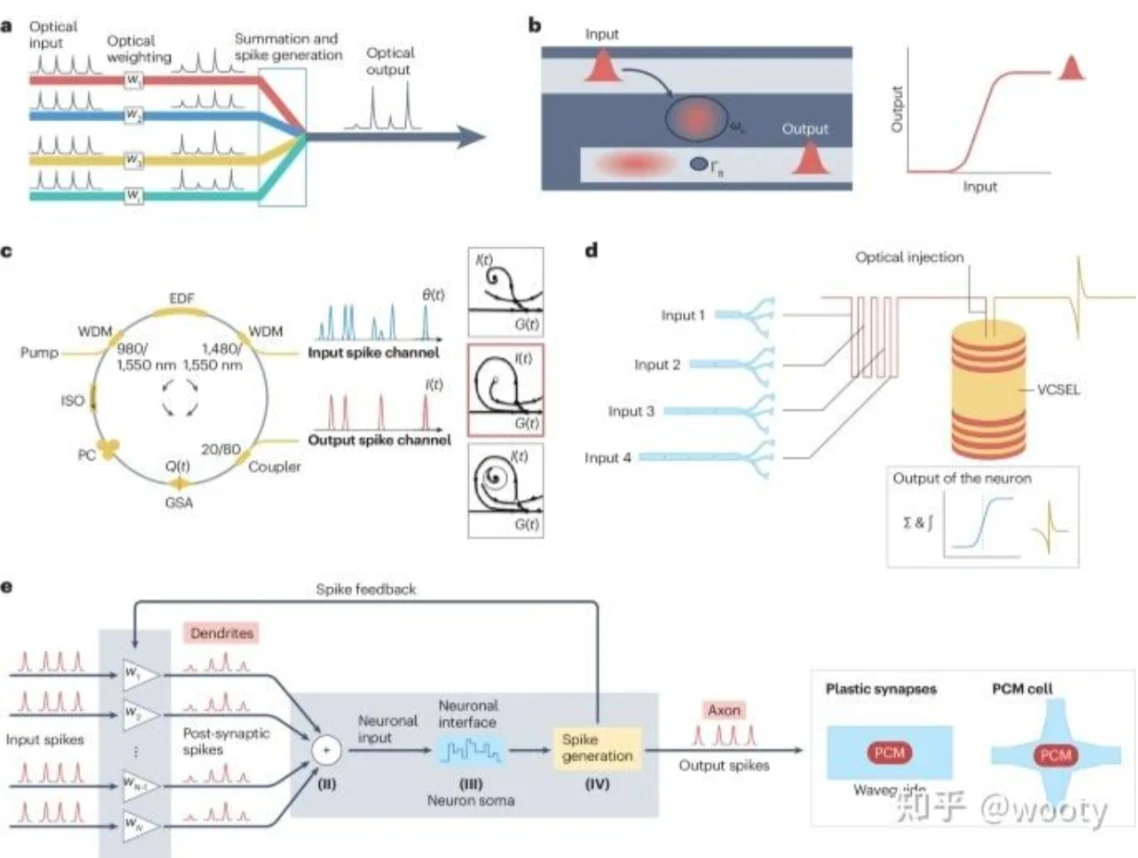
Overall, three key areas for greater scalability and cascadability are minimizing optical loss, optimizing control and feedback systems and algorithms, and using optical degrees of freedom effectively. In other words, optical computing needs architectural design and materials/devices to move toward each other. For now, however, the main problems appear to lie in the materials.
Reference
Farmakidis, N., Dong, B. & Bhaskaran, H. Integrated photonic neuromorphic computing: opportunities and challenges. Nature Reviews Electrical Engineering 1, 358–373 (2024).