Reading Complexity: science at the edge of order and chaos
The origins of the Santa Fe Institute, complexity, interdisciplinary research, and scientific community.
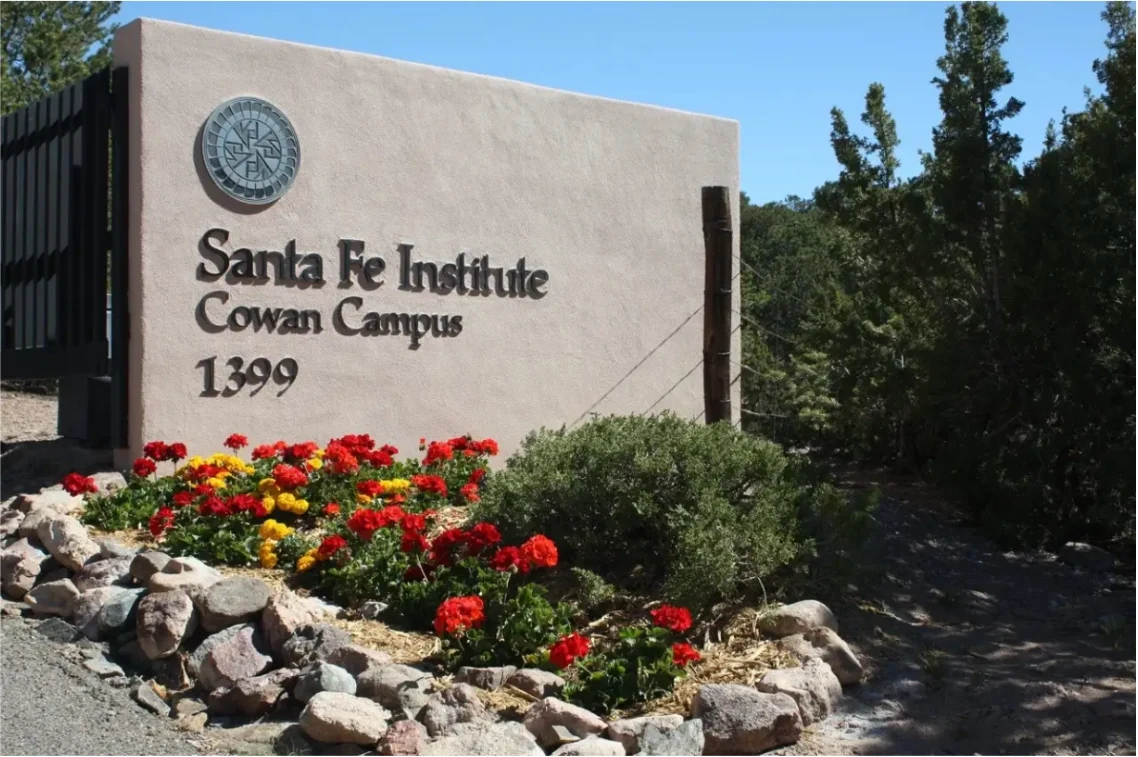
English translation of the author’s Chinese Zhihu article, preserving its original date and viewpoints. Figures retain the original labels; click a figure to enlarge it.
Mind map
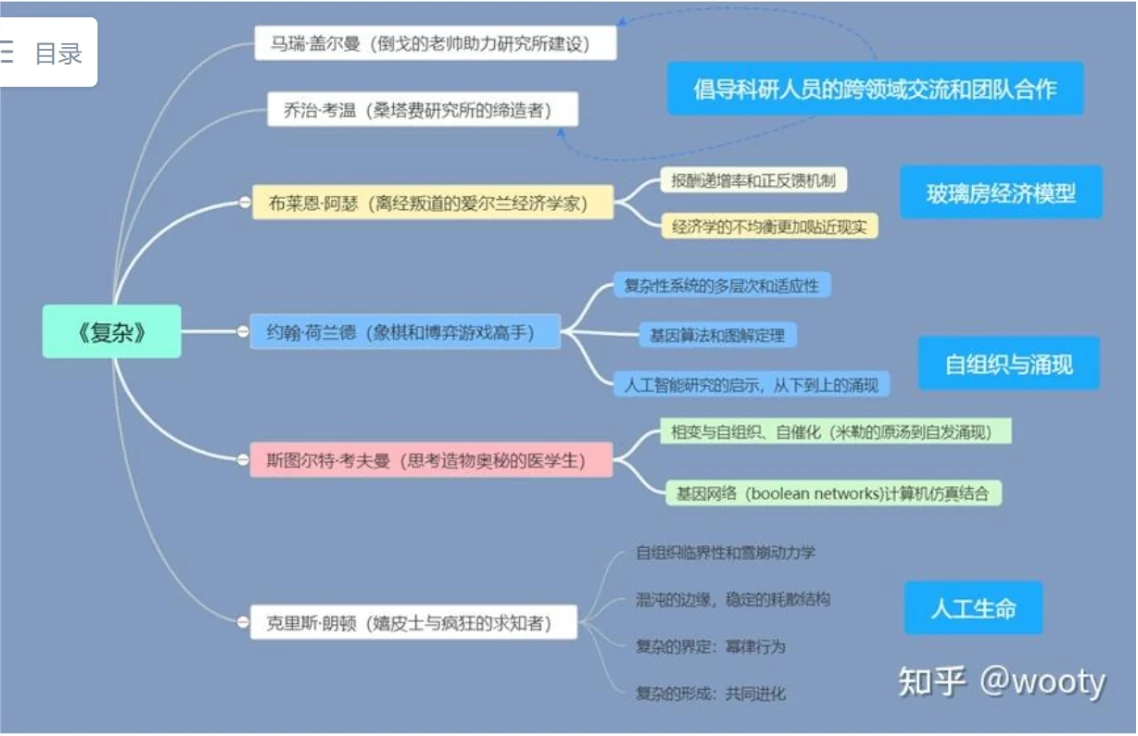
The mind map follows Gell-Mann and Cowan’s interdisciplinary collaboration; Arthur’s increasing returns and nonequilibrium economics; Holland’s adaptation, genetic algorithms, and bottom-up emergence; Kauffman’s phase transitions, autocatalysis, and Boolean gene networks; and Langton’s artificial life, self-organized criticality, the edge of chaos, power laws, and coevolution.
What the book is about
The Irish economist Brian Arthur finally found an outlet for his long-standing doubts about the classical economics to which he had devoted himself. How could elegant, perfect, static mathematical models connect to a messy, complex, dynamic reality? How could Adam Smith’s invisible hand and the rational economic actor explain a stock market so often governed by impulses and random behavior? In opposition to the negative-feedback equilibrium mechanisms of classical economics, Arthur started from positive feedback and increasing returns to develop a new, nonequilibrium view of economics. He found supporting evidence in histories such as the QWERTY keyboard layout and the direction in which clock hands move. Yet, unrecognized by others, he endured years of frustration and financial hardship. That struggle continued for four years, until a haven for unconventional thinkers appeared: the Santa Fe Institute (SFI).
Its founder came from the renowned Los Alamos laboratory, the birthplace of the American hydrogen bomb. His name was George Cowan. In the 1980s, after the Manhattan Project and amid complicated US–Soviet relations, he stepped away from demanding public duties and grew deeply concerned about the atmosphere and philosophy of research. Talented people worked in isolation; universities felt stagnant. Young researchers spent their best years seeking faculty positions, while older ones chased funding. Even the Nobel Prize, the highest honor, seemed to favor beautifully refined reductionist research. What was missing was a holistic, systemic way of looking at the real world, along with interdisciplinary exchange and teamwork. With support from the eminent Nobel laureate and originator of quark theory, Murray Gell-Mann, preparations for the Santa Fe Institute—a fresh current devoted to complexity and systems science—gathered momentum.
Alongside the frustrated economist Arthur, invitees included Stuart Kauffman, who had trained in medicine; John Holland, a master of games and strategic thinking; and the hippie Chris Langton, still working through his doctoral research. Their specialties had little in common. Some had dropped out of university, like Holland; others, like Langton, had broken bones throughout their bodies in a hang-gliding accident. Yet after arriving at Santa Fe, their ideas began to shine: “I may be crazy, but here is a whole group of people just as crazy as I am.”
At lively meetings, physicists, biologists, and economists came together. Initial disdain and arrogance gradually became appreciation, understanding, and mutual inspiration. SFI produced a series of mature ideas: the glasshouse economic model based on increasing returns; computer simulations of gene networks; artificial life characterized by bottom-up self-organization and emergence; the edge of chaos delineated through power-law behavior and avalanche dynamics; and adaptation arising through coevolution, offering a glimpse of nature’s creative mysteries. Together these developments gave form to complexity, a science born at the boundary between chaos and order, concerned with criticality and phase transitions. Growing alongside it was the Santa Fe philosophy: interdisciplinary exchange in pursuit of holistic inquiry.
Reflections after reading
This is a history of the emergence and development of complexity science. It chronicles the rise of the Santa Fe Institute, but also explains how the idea of interdisciplinary, integrative discussion came into being.
Complexity thinking carries into life and deepens our understanding of the world. What is life? Schrödinger’s little book once taught me that life is negative entropy, the opposite of an equilibrium structure. Now that idea has undergone a qualitative change. As Chris Langton reasoned from his molecular automata: the boundary between order and chaos in dynamical systems is “complexity”; between solids and fluids, “phase transition”; between executing and halting a computation, “undecidability”; and between excessive stability and excessive activity in an existing entity, “life,” or, by extension, “intelligence.” Life is not simply nonequilibrium: it is a stable dissipative structure far from equilibrium, a phase transition, complexity itself!
This changed worldview opens new questions about everyday life. Could a celebrity’s overnight rise and sudden collapse reflect self-organized criticality and avalanche dynamics? Could fans’ impulses, amplified by capital into a feverish fandom, be an emergence of Prigogine-like self-organized structures? When tiny online influences spread rapidly across a vast audience, are we not moving from reductionism to systems thinking and toward positive feedback and increasing returns? There are many such questions.
The novel-like narrative gives the book something of the reading experience of “Genius on the Left, Madman on the Right.” Langton’s journey—from an unhappy novice observing monkeys to someone who decisively followed his heart into theoretical physics; from a hippie struggling with drink and drugs to a person rebuilding his life after an accident shattered his body—is an inspiring legend. His ideas are among the book’s most vivid passages. “Do not fear taking the wrong path. Every day, like an eighteen-year-old, you can begin a new journey.”
Arthur thought persistently for thirty years, seeking only to move one small step closer to reality. Scholars who achieve great things also have such troubles. A tenacious character can carry them through four years of struggle, even when everyone else sees them as an unconventional loser. On the day experiments validate the theory, happiness tells them it was all worthwhile. The friendship between Holland and Kauffman—the independent flow and eventual confluence of scientific ideas—is equally moving.
Looking at the past can illuminate the present. The founding of the Santa Fe Institute also offers a glimpse of problems in China’s scientific system. Are Cowan’s complaints about America in the 1980s not being replayed in mainland China today? “Viewed as research institutions, and in contrast to their politics, universities are astonishingly conservative. Young PhDs dare not break with tradition. They have to spend their best years desperately pursuing tenure in a department. That means doing research a tenure committee will approve. Older researchers have to start chasing research funds as soon as they open their eyes. That means fitting research plans into categories foundations will recognize.” “Everyone has to get papers accepted and published in authoritative journals, yet those journals almost exclusively publish work in recognized fields.”
History’s resemblance is startling. Are the talent, emergence, and integrative discussion envisioned by Qian Xuesen not what the Santa Fe philosophy puts into practice? Now that China is the world’s second-largest economy, we should think more about how American science once welcomed unconventional talent and found its way out of stagnation, and about the research conditions under which those achievements were made.
Use complexity in thinking, nurture people who cross disciplines, and interpret the real world.