AI accelerates research but narrows the boundaries of scientific exploration
A reading note on AI, individual scientific productivity, and the breadth of collective exploration.
English translation of the author’s Chinese Zhihu article, preserving its original date and viewpoints. Figures retain the original labels; click a figure to enlarge it. A short passage at the beginning is obscured in the source screenshot and has not been guessed or reconstructed.
As AI continues to empower research, why do disruptive findings across scientific disciplines seem to be declining year by year? Reading “Artificial intelligence tools expand scientists’ impact but contract science’s focus.”
Professor Yong Li’s team moved beyond shallow keyword-based searches. Their approach combines high-quality expert annotation with large language model training to scan scientific literature spanning almost 50 years. Covering the three eras of machine learning, deep learning, and generative AI, the resulting knowledge map encompasses 41.3 million papers and 28.57 million researchers. It provides a benchmark dataset for AI-enabled scientific research and a foundation for quantifying AI’s long-term, systematic influence on science.
To quantify that influence, the team proposed a latent-variable approach to the science of science. They combined high-dimensional scientific semantic embeddings with complex scholarly network analysis and defined a measure of “knowledge extent.” In a 768-dimensional latent embedding space, the diameter and entropy of the vector distribution measure expansion and contraction in the boundaries of scientific exploration.
The analysis reveals a surprising contradiction.
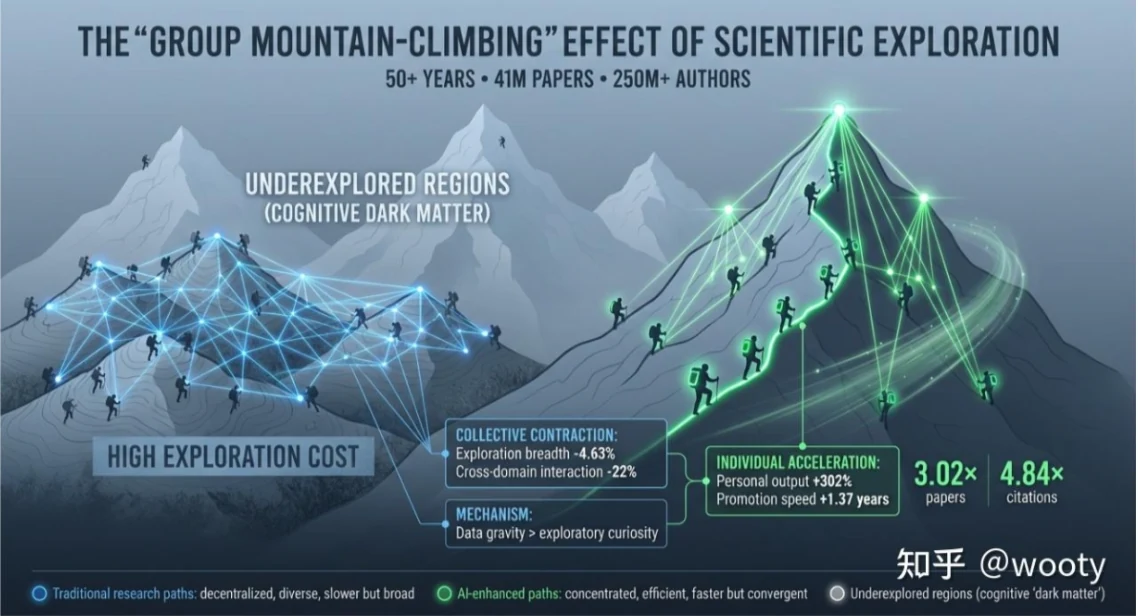
At the individual level, AI helps scientists raise their publication output to 3.02 times the previous level and their citation count to 4.84 times, and become research project leaders 1.37 years earlier.
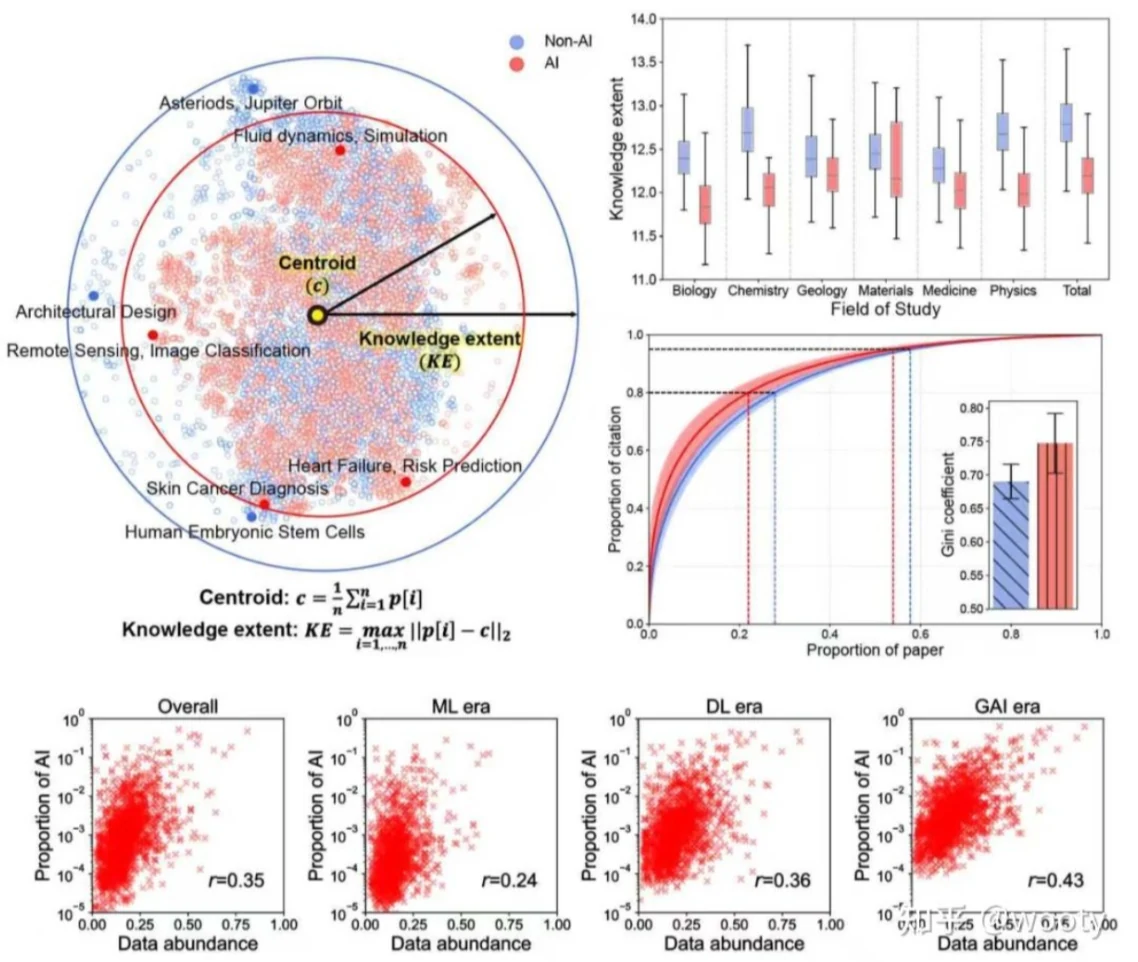
Looking into the mechanism, the team identified a “scientific AI gravity” effect.
AI’s efficiency draws researchers collectively toward a small number of “popular peaks” suited to AI research. This “group mountain-climbing” pattern accelerates the solution of known problems, but also fixes research paths in place and systematically reduces the breadth of exploration toward “unknown peaks.”
(A large-scale data analysis like this can make it into Nature—very clever. I still need to read more papers to develop my taste as a researcher.)
Paper discussed
Qianyue Hao, Fengli Xu, Yong Li & James Evans. Artificial intelligence tools expand scientists’ impact but contract science’s focus. Nature (2026).